There is something in life blooming yet impossible to catch. When you look directly at the flower it disappears. Though askance, from the periphery, the invisible flower.
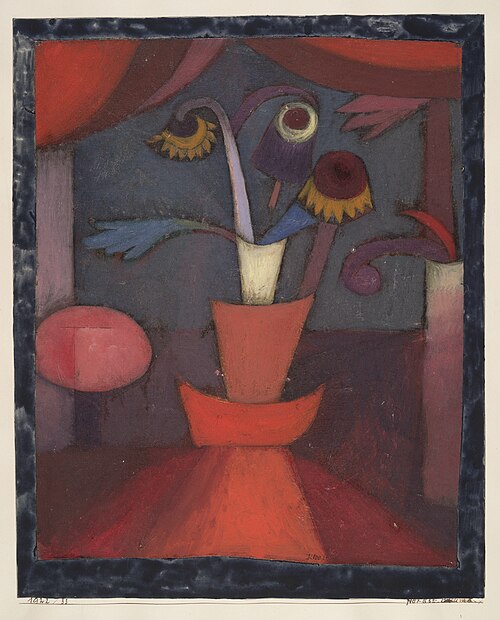
Wiki Commons
In relation to language, to find words you must first have them, although having is likewise an invisibility, as words suddenly arise from nowhere always in becoming, it’s fascinating.
I’m not much interested in “how to write” screeds, though maybe I’m too impatient or stubborn to follow clear instructions. But, having words is worth discussing. How to have them. How I come to have words for this writing, and for poetry. Not words in isolation or groups, and not reasoned words that reason predictably; language that surprises, enlivens, enriches me. How can such language exist already, invisibly? In my last post I discussed ma as a form of “psychopoetic inbetweeness,” this space of finding language could be an extension.
Recently, Robert Macfarlane described how he finds language, commenting:
Q: When you’re with a mountain, with a river, and you’re moved by awe, and you think about translating those emotions into language, how is it that you go about doing that?
RM: First of all, you accept failure. Language will always be late for light. It will never meet water, river, rock, mountain. That moment of encounter is a moment in time and a moment in space when countless streams of being and presence and sensation are all convened in a moment that we call, or we speak of ourselves as, awestruck, wonderstruck, astonished. Language will never catch them. And I think the question is how well language fails. And it’s actually in the shattering of language, as it falls to pieces around the untouchable moment, that for me the beauty comes: how the pieces fall, what they’re made of, and what happens when you’re out in the field, and what happens when you’re at home at the desk. (19 Aug 2026)
At 26, I became devoted to formless meditation. It’s a practice that over time goes deeper than the self, or illusions of self-concept. Some years later, in a cabin in the remote Sangre de Cristo mountains, dead of winter on solitary retreat at 8,200 ft, I first glimpsed the invisible flower, or it glimpsed me. And this flower has remained, if invisibly. Eventually, I needed to return to the working world—down the long, long endless highway back to home occasioned hours of tears, attendant upon the knowledge of a coming loss of awareness.
Snow too deep for walking and afraid at night for bears I knocked over the single light, dead of night, a kerosene lantern. In blind dark just the fumes before searching hands. Was that a knocking? Psyche merges with body and world: what’s inside and outside merge. Eighteen or more hours a day over weeks in meditation in complete isolation. On the back of the upper neck hairs sometimes standing. No time tomorrow, no time particularly. This was long after giving up on any enlightenment project.
I won’t laugh but do smile, remembering. In an era before cellphones, there were no communications. The instruction is to remain sitting, adamantine. This was the one time I lost it.
Throughout, a process of recovering, disclosing, abandoning, remaining. Over the nights and days the body increasingly became transparent, or diamondlike. There were visions of different sorts, and often what arose completely unbidden was an inexpressible clarity.
Sitting meditation is worthwhile—though if taken like a pill ineffective as a mere antidote, or productivity increase, or mindfulness “benefit,” as promotors often claim. Expectations are gradually or quickly found to mislead or dead‑end; the more you think you know the more time is wasted. Over time, wild mind comes and goes, returns, remaining naturally wild—as if in an endless meadow the wild horse of mind is never broken but quietens, then gradually begins to eat, as nourishment is literally everywhere. The self becomes the least, most incidental, transparent thing. The possibility of seeing‑through invisibility is self‑transparency, not the you of you, or me of me.
Traditionally it’s gauche to discuss mystical-visionary experience in formless meditation, as “phenomena” are beside the point and it sounds so pompous! But I’ll stick up for the boldness of being. Having lately read tripe concerning the uselessness or irrelevance of meditation, its ineffectiveness. The boldness of being: so bored you sweat, fret, and would do anything to surrender to movement, return to “doing,” to normalcy—doing even the least little other thing.
To keep on keeping on, from hot to cool boredom, to what is further and further on—that being is inexpressible. It’s not occasioned in Western philosophy, that I can see. It’s tough: like any true craft. Expertise involves putting in a good deal of effort. Those years, monthlong and intensive retreats—the process is nonlinear, there’s no point where you can say I got B because of A, or X, Y, Z out of it. A compassionate path of direct psychic, psychological, and poetic investigation—sensitive artistry develops as an aspect of such investigation, and psychological vulnerability; being open you are likely to fall in love in some way. Time and loyalty to the practice—just like other forms of craft. Psychoactives tend to distract, they aren’t shortcuts; just different ballgames in different leagues (don’t be confused).
I’m not the same person who walked up that mountain.
“It’s actually in the shattering of language, as it falls to pieces around the untouchable moment, that for me the beauty comes.” As a meditation travelogue I’ve not done a proper descriptive job, though Macfarlane’s comment reminds me of “that moment of encounter . . . awestruck, wonderstruck, astonished”—so, I wanted to tell you this story.
The song we’re able to sing quietly alone, becoming the invisible flower. Even if language fails and falls to pieces around each untouchable moment.
once one lonely vowel
forgotten longings
so round
— RG
Comments are welcome at The First Book (my Substack). If you value this work, support it by becoming a paid subscriber, or donate to Heliosparrow.